JUACO. SiembraViva
Prepared for Philip Morris International · Global Agronomy

Broader Reach. Timelier Decisions. Healthier Soils.
Triple the farms each field technician can reach — and act in time to protect yield and build soil health.

SiembraViva · JUACO — Inteligencia regenerativa
How it works · the way a good doctor works

From “not sure” to “here’s what to do.”

1
Spot it
The symptom
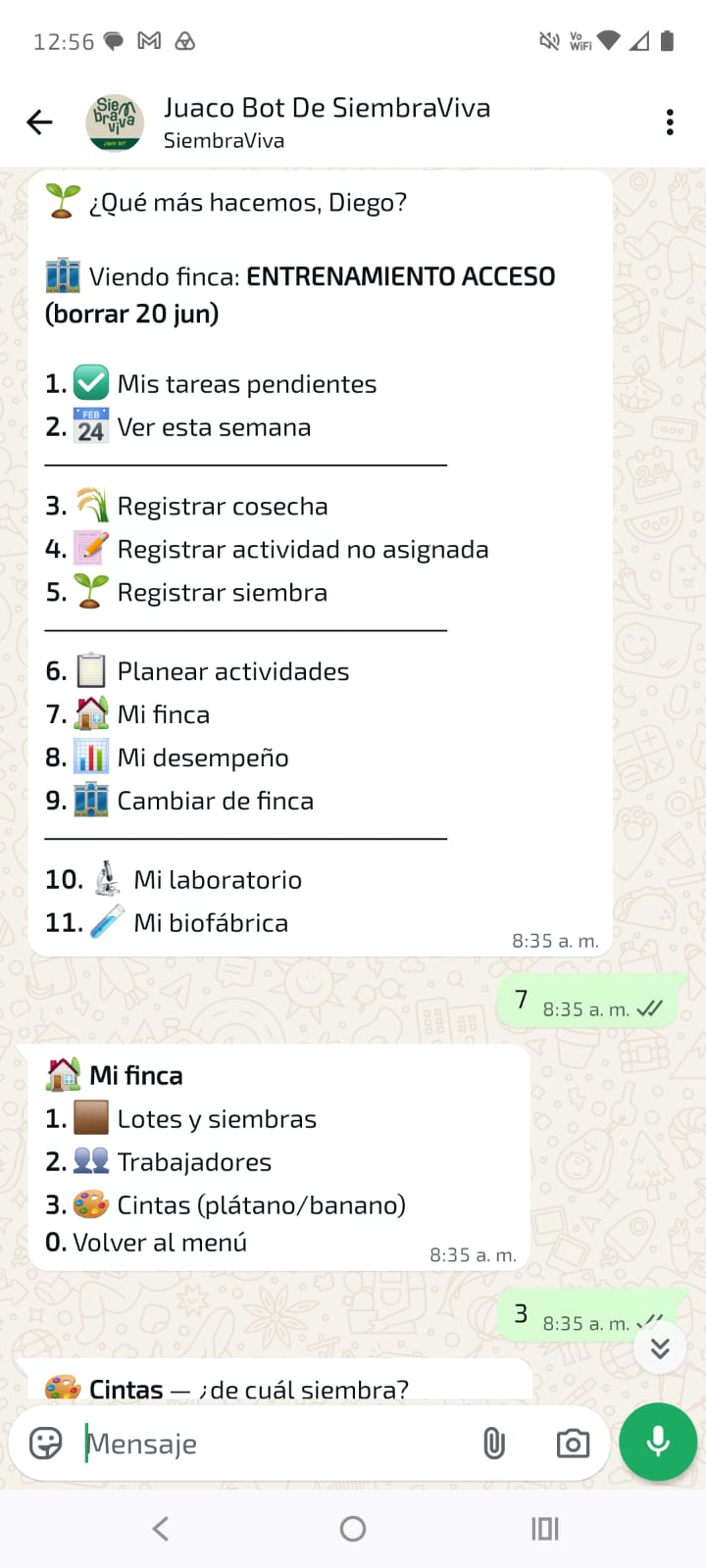
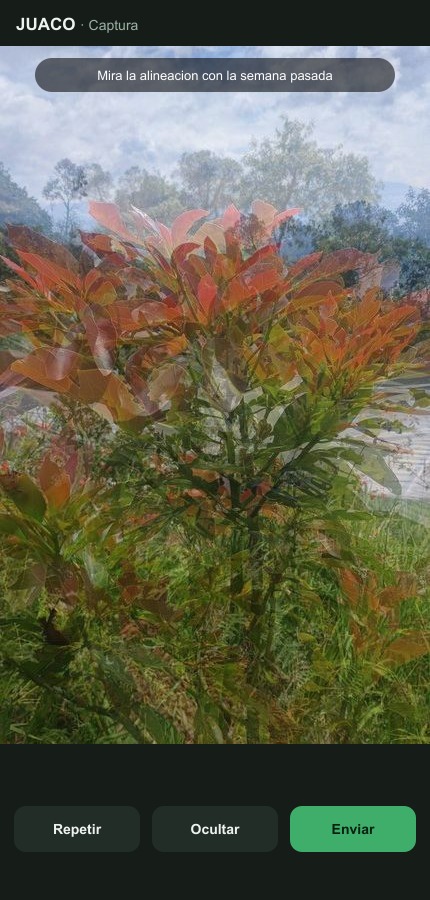
A weekly photo and voice note on WhatsApp, from the grower’s phone.
Monitoring + Field records
2
Understand why
The blood test and the scan
Sap and microscopy by zone: what the plant is taking up and what’s living in the soil.
Sap + Soil biology
3
Decide what to do
The specialist
The cognitive engine pulls it together and proposes the adjustment for that farm — no blanket recipes. Your agronomist decides.
Cognitive engine
4
Rebuild the soil
The treatment
A lab and a community bio-input plant in the area, set up by SiembraViva: biological inputs made locally.
Bio-inputs + Lab
Step 1 · Reach: the grower’s phone

How is the crop doing this week?

A photoVigor, growth stage, plant health and soil.
A voice noteEverything done on the farm, on record.
Every week, no travel neededThe grower sends it on WhatsApp.
Step 2 · Depth: one lab per zone

What’s really going on?

SapThe blood test: what the plant is taking up right now.
Soil biologyUnder the microscope: the functional groups that cycle nutrients.
By zone, 10 plants per fieldA zone that behaves differently? One more sample and a few more photos. No extra sensor.
Soil fungiµg per gram · Coffee, Nicaragua
0125250Jun 2025Mar 2026Program · 28 Jun 2025: 3 µg/gProgram · 11 Nov 2025: 112 µg/gProgram · 6 Dec 2025: 217 µg/gProgram · 17 Jan 2026: 149 µg/gProgram · 13 Mar 2026: 153 µg/g153ProgramControl · 28 Jun 2025: 3 µg/gControl · 11 Nov 2025: 4 µg/gControl · 6 Dec 2025: 5 µg/gControl · 17 Jan 2026: 23 µg/gControl · 13 Mar 2026: 6 µg/g6Control

Program field versus its control. Fungi rose from 3 to 153 under the program; the control stayed at 6.

Calcium in sapppm, new leaf · Vegetables, Colombia
0150300Dec 2025Sep 2026New leaf · 17 Dec 2025: 270 ppmNew leaf · 10 Jan 2026: 160 ppmNew leaf · 21 Jan 2026: 190 ppmNew leaf · 5 Mar 2026: 110 ppmNew leaf · 30 Sep 2026: 76 ppm76New leaf270

Five readings, one trend: calcium is falling — visible in the sap before it shows on the leaf.

Actual lab data, as shown in each farm’s audit view. Each point is one sample.

What your agronomist sees · three times the reach

One technician, three times the farms. And a clear call list.

All their farmsEach with its three indices and the date of the data.
A farm with no score shows what still needs measuringThat’s this week’s call list.
One tap on any farmFrom the network view to the task, and from the task to its photo.

Plantain · Urabá, Colombia. Live network view, October 13, 2026; names blurred.

Association network view
The farm’s tasks
The farm · its tasks, with photos
Evidence photo: soil cover in a plantain field
The photo · task: “Cover the soil”
Not an experiment

Already working at scale. With measured results.

× 3
growers per technician: 40–60 → 120–150 with our clients; in tobacco, the trial measures it
135
active farms in 4 countries
68%
still active after 3 months
−73%
fertilizer cost per tree, with 24% more fruit · Lime, Mexico
3 → 153
µg/g of soil fungi; the control stayed at 6 · Coffee, Nicaragua
1–5 → 6–20%
Sigatoka from the weekly photo: flagged “assess spraying” that week, not a month later · Plantain
≈ 26 t CO₂
per hectare per year (7 t of carbon) at a 1:1 fungal:bacterial ratio · a conservative reference on David Johnson, NMSU (~10 t C)

Usage: JUACO data, Jun–Sep 2026. Results: individual farms, external lab, control where available. Carbon: Johnson, Ellington & Eaton (2015, preprint), 10.27 t C/ha per year over 4.5 years; we use 7 (× 3.67 = CO₂). The pilot measures it on your farms: baseline and endline, same point and method.

Cost vs. benefit

For the cost of a sensor: the reach of an app and the depth of a lab.

A sensorA labAn appJUACO
Cost per grower per yearUSD 250–470USD 1,400–1,800USD 5–10USD 320
Reach: covers your whole network without multiplying the cost✕ one device per farm◐ every sample billed✓✓
Depth: measures plant and soil, zone by zone◐ one point, one reading✓✕✓
Recommendation: specific to each farm, not a recipe✕ raw data only◐ a report, no action plan◐ one-size-fits-all✓

USD 320 per grower in year one. From year two, growers fund it from their input savings.

Sensor: weather stations, soil probes and in-plant sensors. Lab: 12 sap and 6 soil-biology tests a year at list prices. App: platforms companies use with their grower networks. Estimates based on published prices; SiembraViva research, October 2026.

The next step

A trial with your growers, side by side with your agronomist.

3 to 4 months · before transplanting
Preparation
Local lab and bio-input plant running. Soil and sap baseline.
One tobacco cycle
The crop
JUACO farms versus control farms, with your agronomist. Leaf quality measured against your criteria.
At the end
Decision
Three yeses and we scale.
1Did each technician triple their coverage without lowering the quality of support?
2Did the grower group cut input spend by 20% by the end of the cycle?
3Did beneficial fungal biomass rise by 30% by the end of the cycle?Soil rich in fungi and oxygen loses less nitrogen as nitrous oxide — a gas about 300 times more potent than CO₂.
Let’s talk Diego Benítez diego@quierosiembraviva.com +57 310 442 9598 siembraviva.com
SiembraViva · JUACO — Your agronomists’ judgment, with three times the reach
↑ ↓ to navigate